It’s a little overdue, but time to take a close look at the Relative Runs analysis from the 2026 IPL season. I did something similar for the 2025 season (which you can read here), and it was both fascinating and fun to see which players stood out in terms of my novel metric, Relative Runs, in the world’s premier T20 franchise league.
Before we get stuck into it, a little overview of the approach is needed. It’s important before reading on to understand what Relative Runs are (from here on, ‘ЯR’)…
In short, they are a novel statistical take on runs which, like my other Relative metrics, looks to quantify the relative contribution of batters to their sides, rather than the absolute or ‘raw’ runs. The calculation is simple: you take the total of an innings minus the extras, and then divide that by the number of batters who faced a ball. This gives us our ‘Par’ score for the innings. ЯR are then determined by subtracting the Par from the actual runs scored by a particular batter.
The core idea behind the metric is that what matters for this stat is how many more or fewer runs a batter scores than the average contribution of their peers in an innings. You can read a bit more about how the stat works here.
For the recent IPL season, just like last year, I went through every match and collected ЯR scores for every batter in each innings, along with some other Relative stats, too. Once the season wrapped up, I began tallying the total ЯR scores for the top batters (the top 60 run-scorers plus a few more). I then determined the average ЯR per innings of each of those batters from across the season – simply their ЯR divided by their number of innings – to determine the key stat in what follows: ЯR/Inns.
This stat tells us how many runs a batter scored more or fewer than the Par score of his teammates, on average, throughout the season. To illustrate: a batter might gain a ЯR score of 10 in one innings, but just 2 ЯR/Inns across the season. This would indicate that he averaged 2 runs more than the Par score of his teammates throughout the season, but scored 10 more than the Par in one particular innings.
Like anything, the more data, the better. Inspecting a ЯR score is interesting, but looking at ЯR/Inns scores from across a whole season of 10-15 innings is much more illustrative of over- or under-performance. This is the main reason why my analysis tends to focus just on the batters who scored the most runs in the IPL, as they are also the ones who tended to play the most. We want to see the stat ‘in action’, so to speak, with decent-sized datasets – not just one or two innings. We will return to the discussion of sample sizes in what follows below.
To begin with, I’ll take a look at just the top 20 scorers in the 2026 IPL season, before broadening that out to the top 60, and finish with a couple of other curious outside cases and reflections. I hope you enjoy reading and find it as interesting as it was to put together!
The top 20 scorers: Sooryavanshi the star as Marsh impresses again
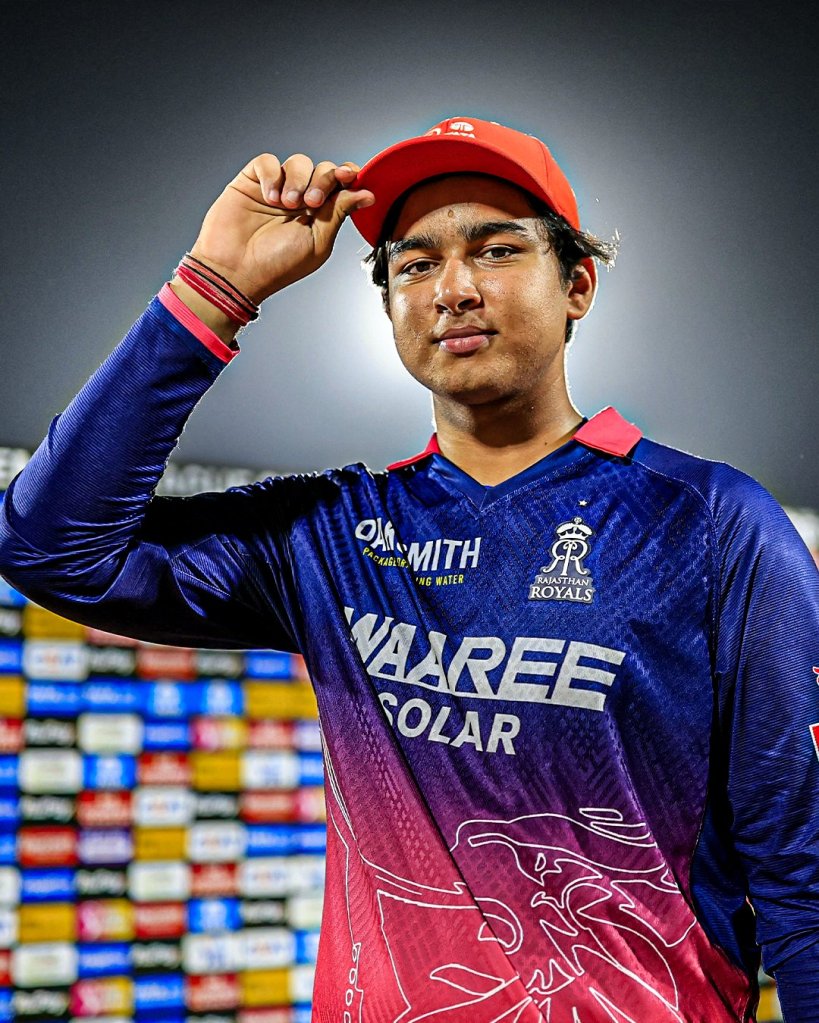
There’s only one place to start this analysis, and that is with 15-year-old sensation Vaibhav Sooryavanshi of the Rajasthan Royals. The Orange Cap winner blazed 776 runs in 16 innings at an absurd strike rate of 237.30. There are not enough words to describe his impact on the IPL, and the game at large, really.
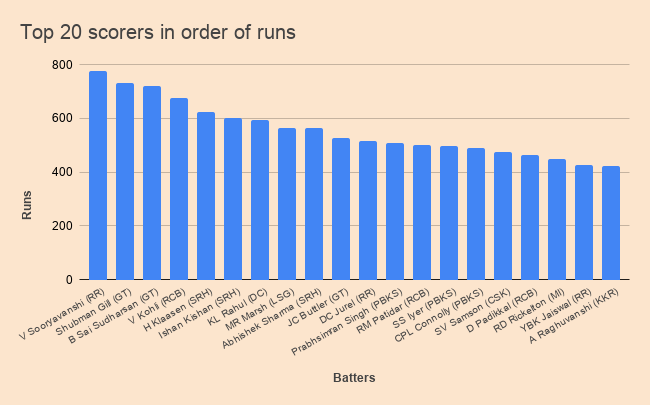
Needless to say, given his output, it’s unsurprising that he gained the highest ЯR/Inns score of the entire competition of 23.54, after a total 376.67 ЯR from 16 innings. Having scored about 25 per cent of his side’s runs in the season, it stacks up that his relative contributions across innings are going to be very high too.
To put his numbers into some context: in the previous season (2025), Mitch Marsh led the competition with a ЯR/Inns of 20.54 ahead of three players scoring between 17-18. Sooryavanshi’s heavy outscoring of his teammates and sheer weight of runs make him a logical ЯR and ЯR/Inns leader, but his numbers are nonetheless very impressive.
Only two other players scored more than 700 runs in the 2026 IPL – Gujarat Titans pair Shubman Gill and Sai Sudharsan. They are in the top 6 in terms of ЯR/Inns, with Gill 3rd on 17.82 and Sudharsan 5th on 15.05, among the top 20 scorers. Superstar Virat Kohli, who helped RCB to back-to-back titles, notched 14.39, which has him 6th ahead of Sunrisers’ Heinrich Klaasen (13.93) in 7th place.
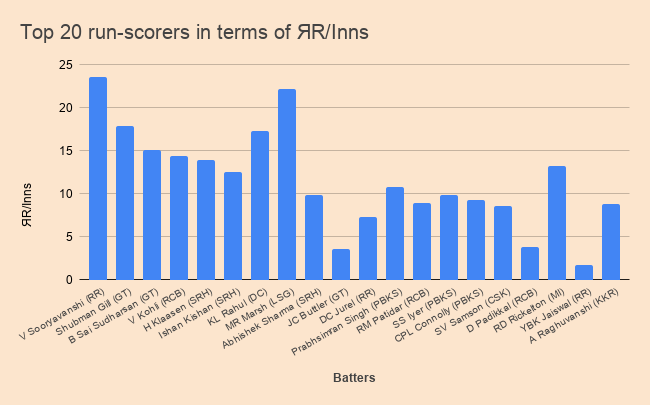
Coming in with the 2nd best ЯR/Inns score of the top 20 run-scorers is Mitch Marsh, last year’s ЯR/Inns leader in the IPL. LSG had a diabolical season, finishing dead last, but Marsh did his bit at least, scoring just shy of 21 per cent of his side’s total runs. His ЯR/Inns score of 22.23 was better than his 2025 numbers and bettered only by Sooryavanshi and one other player in the top 60 run-scorers in 2026 (more on the other below).
Delhi Capitals’ reliable and somewhat overlooked (in this format, at least) KL Rahul comes in 4th, wedged between the GT openers, in terms of ЯR/inns with a score of 17.32. By far the top scorer from DC (the only one in the top 30), Rahul goes about his business in a way that hasn’t drawn as much attention as his fellow Indian openers mentioned above, perhaps because his franchise last made the playoffs in 2021. Here’s an interesting tidbit: Only 6 players scored more runs than Rahul all season, and of those, only 2 did it at a higher strike rate – Sooryavanshi and Sunrisers’ Ishan Kishan (12.47 ЯR/Inns – 9th best of top 20).
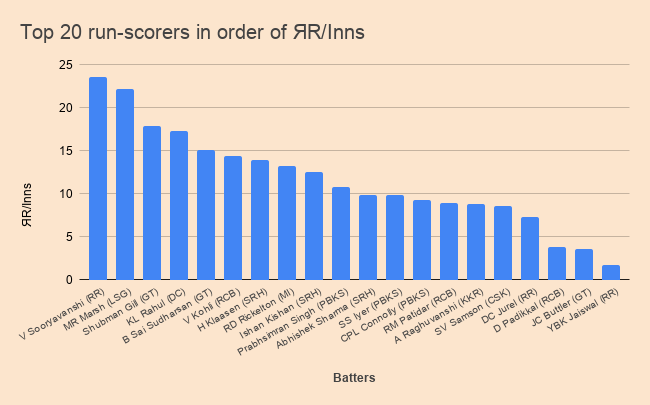
Further down this list of the top 20 scorers, Mumbai’s Ryan Rickleton stands out for having the best ЯR/inns outside the top 9 run-getters at 13.23 (8th best in top 20 batters). Rickleton was rather surprisingly dropped at one point during the campaign, only to come back into the fold. He scored more runs than any other MI player, despite only playing 12 matches. It was thus surely a mistake to drop him, and you’d hope they’ll stick with him next season to begin with.
Punjab Kings spread their runs around in what was a pretty bizarre campaign for them, winning 6 straight before losing 6 straight. Their top scorer was Prabhsimran Singh (10.73 ЯR/Inns), who, along with Rickleton, was the only other ЯR/Inns score over 10 outside the top 10 run-scorers but inside the top 40. Teammates Shreyas Iyer (9.81) and Cooper Connolly (9.27) came very close to joining that group too, however. As did RCB’s Rajat Patidar (8.92).
Another player close to the 10 mark for ЯR/Inns was KKR’s top scorer Angkrish Raguvanshi, who caught the eye last season with 6.88 ЯR/Inns, but bettered that in 2026 with 8.76. In terms of this metric, that puts him above the likes of CSK’s Sanju Samson (8.56), GT’s Jos Buttler, RCB’s Devdutt Padikkal and RR’s Yashasvi Jaiswal for 2026, who all scored more runs in the season.
Speaking of that lot… Buttler (3.52), Padikkal (3.80) and Jaiswal (1.73) all ended up on ЯR/Inns scores below 4, placing them as the lowest 3 in the top 20 run-getters according to the metric. Theirs are still positive numbers but dwarfed by their teammates.
Buttler and Padikkal, the typical No. 3s in both finalist sides, stood in the shadows of their respective openers – Gill & Sudharsan or Kohli – who tend to bat long and hog the runs, making it harder to shine in terms of ЯR for those that come in after them. Jaiswal, similarly but in a more extreme sense, scored almost 350 fewer runs than the top scorer in his team, Sooryavanshi. That goes a long way to explaining why both the teenage phenom recorded such a high ЯR score, and why Jaiswal registered under 2 ЯR/Inns.
Aside on the difference between the percentage of team runs and Relative Runs
One topic that is doing the rounds in cricket stat conversations a lot recently, and came up above, is referencing the percentage of team runs scored as opposed to just ‘raw runs’. It’s great to see, because this goes some way to exploring the relative contributions of players over absolute contributions. One quick note on this is that when looking at the 2026 IPL season, the percentage of team runs maps not perfectly but quite linearly with total runs.
What that means is that while it is a great indicator of relative contribution, in the context of a tournament like the IPL where scores do fluctuate but teams face similar conditions, the story that percentage of team runs can tell us is interesting but not as nuanced as Relative Runs. That is because Relative Runs has baked into it the difference in the weight of runs that are shared between many and few batters. To put this another way: you could score a large proportion of your team’s runs, but score few Relative Runs if the Par score is high due to fewer batters being used.
The top 60 scorers: Inglis surges into conversation
When we broaden our analysis out to the top 60 run-scorers in the competition, there are some intriguing results. The top 60 accounts for players who have scored at least 170 runs in the season. What I was expecting to find with this bigger group was most players following the trend line, with some players of slightly smaller samples generating eye-catching ЯR scores, as in 2025.
These are the guys who maybe don’t lead the way in terms of core numbers but outperformed in a smaller set of matches, either because they weren’t picked initially or got injured or fell in and out of favour. We got a nice collection of those players further down the run charts, plus one absolute outlier, as you can see in the graphic below.
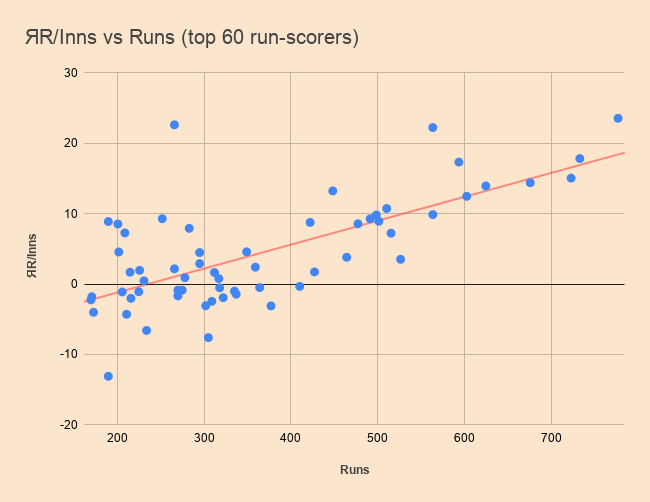
When we broaden our analysis out to the top 60 batters, LSG’s Josh Inglis surges into second place in terms of ЯR/Inns thanks to his excellent stint of just five matches at the backend of the competition for the rock-bottom side. His ЯR/Inns of 22.62 is staggeringly good, considering he’s probably gone under the radar of most casual fans, given just how bad LSG were and out of the playoff picture for much of when he featured.
Inglis’ short run included scores of 13, 85, 36, 60 and 72 at an average of 53.20 and a SR of 186.01. His ЯR/Inns score indicates that he scored almost 23 runs more than the Par score of his side, on average, each innings.
Of course, Inglis is aided by having a smaller sample of just 5 innings. Perhaps, if he’s available from the start of the season, his numbers regress a bit. But equally, perhaps they don’t, and he’s one of the tournament’s leading batters. This is a really fun example of how this stat can highlight a player lower down the runs charts that might otherwise go a little unnoticed.
With Inglis’ teammate Marsh posting similar ЯR/Inns numbers over the season, it is worth noting how curious it is that the worst team might present 2 of the top 3 players regarding this metric. However, based on how the metric is constructed, it is also understandable, as it aims to highlight over-performance. Both Marsh and Inglis benefited, in terms of this particular metric, from being good batters in a bad team.
More specifically, it is the kind of bad that their team was that highlights them – the next two batters from LSG in terms of ЯR/Inns were Ayush Bodoni and Rishabh Pant, who notched 1.68 and 1.64, respectively. Both of those were outside the top 33 ЯR/Inns scores in the top 60 run-scorers. In that range, only LSG and DC had fewer than 3 players represented, with the former contributing their two 2 Aussies to the top 3.
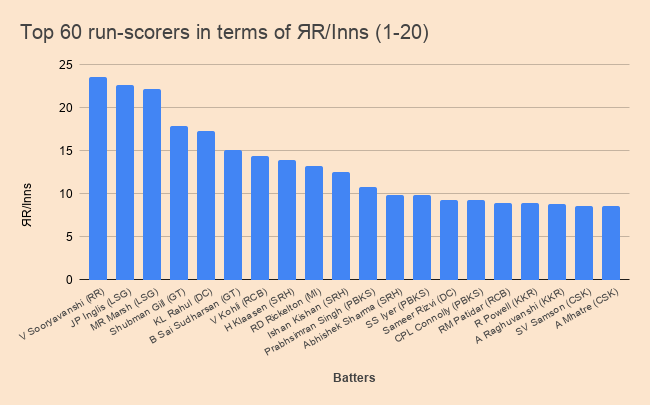
It is also worth noting that Marsh was the only LSG player in the top 30 run-scorers, another illustration or explanation as to how he could be close to leading the league in ЯR/Inns from such a bad team. Considering Marsh garnered the top ЯR/Inns score in the entire competition in 2025, he and Inglis are the two batters LSG should build next season’s top order around, you’d think.
Rizvi, Rohit and Rovman: Other players of note in the top 60
If we consider this larger cohort of 60 batters, there are a few other names that pop out in terms of ЯR/Inns…
Coming in at 14th in the completion with 9 matches played is DC’s Sameer Rizvi, who notched 9.28 ЯR/Inns. Rizvi had a curious season, starting really strong with 160 runs across his first 2 outings, then added just 92 more in a further 7 innings before being phased out of the side. His dip in productivity explains why he was dropped, but it is interesting to note that he trails only KL Rahul in terms of ЯR/Inns for DC. What’s more, Pathum Nissanka (0.91) is the only other Delhi batter with a positive ЯR/Inns score inside the top 60 run-scorers.
Other players with smaller samples (sub-10 matches) that catch the eye in the top 30 ЯR/Inns scores are KKR’s Rovman Powell (8.87), CSK’s Ayush Mhatre (8.53), MI’s Rohit Sharma (7.91), as well as Venkatesh Iyer (7.26) and Phil Salt (4.56) of RCB. All of these 5 have different stories as to why they played a bit less…
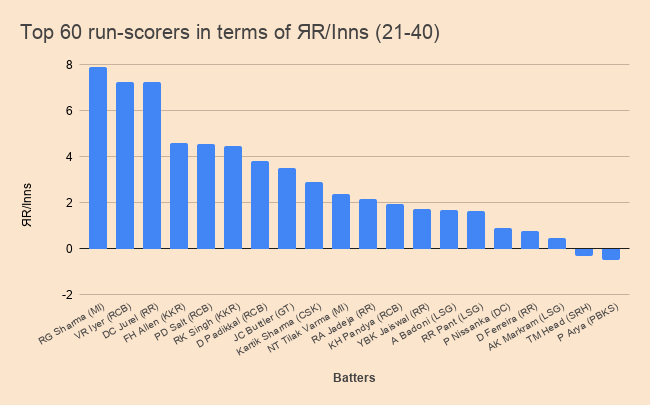
Starting with the RCB pair, Salt began the season opening and played 6 matches before getting injured. Meanwhile, Venkatesh was used as an impact sub sporadically before getting a go in the opening slot after Jacob Bethell also got injured. Of Kohli’s three opening partners, Venkatesh performed the best in terms of runs and ЯR/inns, albeit in more than just one role. Considering he was thriving at the top in the finals, Venkatesh might have made the job his to lose.
Rohit Sharma just won’t go away, will he? The MI veteran was another player who suffered from injuries in the season, missing 5 straight games in the middle of the main phase. MI had a season to forget on the whole, winning just 4 matches and only finishing above LSG on net run rate. It was truly disastrous, and Rohit missing a chunk of matches only added to their chaos, with the side seemingly unable to settle on combinations. Rohit’s ЯR/Inns puts him behind only Rickleton for MI inside the top 60. Of the 4 matches they won, he played in 3.
Like MI, another of the league’s big dogs in CSK had an up-and-down campaign – starting and ending the season with three straight losses on either side of a good run of 6 wins in 8. Last season, we flagged Ayush Mhatre as having one of the better ЯR/Inns scores outside the top scorers. Mhatre ended the ’25 season with a ЯR/Inns of 12.02 from seven innings. This season he didn’t better that, but he did still rack up 8.53 from 6 matches.
While last year saw Mhatre break into the CSK side, ‘26 began with him in the XI before suffering a bad injury, which curtailed his campaign. That was a real shame because he’s now put in two good half-seasons, and next year he should surely be among their first-picked batters. Only Sanju Samson (8.56) had a better ЯR/Inns score in the side, with Kartik Sharma, another young gun, posting an encouraging 2.90 from 11 outings – the third best from CSK among the top 60 scorers.
KKR were another messy team in ’26, tinkering with their top order a lot and failing to find consistency at the front end of the season. No one from the side breached the top 16 ЯR/Inns scores among the top 60 run-scorers. CSK were the only other franchise to earn that dubious honour. We mentioned Raguvanshi already, who top-scored for KKR. However, Rovman Powell, who featured in 11 matches but only batted 7 times, pipped Raguvanshi to a higher ЯR/Inns score, with 8.87 from his innings.
Only just inside the top 60 run-getters, Powell makes a decent claim to be considered KKR’s most underrated batter from 2026 for that reason. Only 4 players from KKR in the top 60 landed positive ЯR numbers: Powell, Raguvanshi, Finn Allen (4.58) and Rinku Singh (4.47). That could (or should) be 4 of their top 6 next season, but with so many overseas players to squeeze in, it will be interesting to see if Powell gets recognised for his season just gone or gets squeezed back out of the XI as he was at the start of the 2026 season.
Personally, I’d prioritise Powell based on these numbers. Cameron Green scored negative ЯR(-1.93) but should hold his place as the allrounder and marquee man; then you could have Powell, Allen, Sunil Narine (if he’s still going) as the other overseas picks. One of the reasons Powell batted a bit less was not just being overlooked initially, but also because he is often used as a lower-order hitter, sometimes not being required if the top order does well. Another way to look at his impressive ЯR/Inns scores from 2026 could be to say that he should be elevated in the batting order ahead of the likes of Green and Rinku, who both scored more runs but relatively contributed less.
Further afield and final thoughts
Outside the top 60 run-scorers, Quinton de Kock scored 132 runs in just 3 innings, with 112 of those coming in one surprise knock. That left him on a ЯR/Inns score of 23.01, which would be the second best among the players considered, but it felt like too small a sample to include. This is an example of why the top 60 feels like a good cut-off for the core analysis – if you broaden it too widely, you end up with too many players with small samples. In fact, Josh Inglis is the only player in the top 60 scorers who played fewer than 6 matches, and even his 5 innings are on the edge of permissible.
Another interesting player outside the top 60 scorers, actually just one place outside it, is Sarfaraz Khan. Playing in the first 8 matches for CSK, Sarfaraz landed a ЯR/Inns score of 2.92 from 7 innings. That actually puts him above Kartik Sharma, who we mentioned earlier, and more intriguingly, above even his captain Ruturaj Gaikwad (-1.44) and CSK mainstay Shivam Dube (-0.87). Sarfaraz was a slightly surprising purchase by CSK in the 2025 auction and even more surprising performer in 2026, but he was, as often seems to be, the one dropped when the season was slipping away. Perhaps he’s a batter to keep an eye on next season if he can get a run of games again.
There are further players to explore and more insights to draw, but that feels like a pretty exhaustive overview and analysis of the core ЯR stats from the top batters in the 2026 IPL season. We’ve jumped from team to team, touching on the leading scorers, many talking points, and more importantly, the players whose ЯR stats tell a story that traditional batting stats cannot or do not.
Essentially, the stat is about finding hidden value or value that traditional stats cannot show. Of course, we didn’t need this tool to prove that Sooryavanshi was the star batter of the season, but perhaps we do need the stat to add colour to his performance. More pertinently, we can use ЯR to identify and quantify the value of guys like Marsh and Inglis, who did very well in a poor team; or to make selection cases for players who were dropped like Rizvi or players who were otherwise underused like Powell.
Hopefully, Relative Runs and the above analysis have shone a new light on the 2026 IPL’s best batters for you. At the end of the day, that’s the aim!
2026 IPL Relative Runs Summary
Most Relative Runs in the season:
Vaibhav Sooryavanshi (376.67), Mitch Marsh (289), Shubman Gill (285.19), Sai Sudharsan (255.79), KL Rahul (242.53)
Most Relative Runs per innings (of the top 60 scorers):
Vaibhav Sooryavanshi (23.54), Josh Inglis (22.61), Mitch Marsh (22.23), Shubman Gill (17.82), KL Rahul (17.32)
Most Relative Runs in a single innings:
Ryan Rickleton (89.43 for his 123* vs SRH), KL Rahul (87.75 for his 152* vs PBKS), Cooper Connolly (85.56 for his 107* vs SRH), De Kock (85.29 for his 112* vs PBKS), Abhishek Sharma (76.5 for his 135* vs DC)


Leave a Reply