Tag: sports-data

  • Quantifying Bumrah’s brilliance at the World Cup via Relative Economy

    Everybody knows Jasprit Bumrah is going to go down as an all-time great. And not just in one format of the game, but all three. He’s an automatic pick in world XIs for Tests, ODIs and T20s. Recently, at the just gone T20 World Cup, he only underlined his 20-over prowess, claiming the most wickets in the tournament (14) at an average of 12.42 and a frankly astonishing economy rate of 6.21.

    Those numbers in and of themselves tell a story of someone being incredibly effective in both an offensive and defensive sense, simultaneously. And therein lies the key to Bumrah’s greatness: he’s the best of both worlds in one bowler.

    Now, I don’t intend to argue with that fact at all in what follows. On the contrary, I want to further explicate just how good Bumrah is by telling a little data story. And do that, I’m going to draw on one of my stats from the Relative Runs universe. Namely, Relative Economy (ЯE). But before we get to Bumrah’s numerical story at the World Cup, let me just explain the stat briefly…

    What is Relative Economy?

    Where Relative Runs look to quantify the relative value of a batter’s runs, and in so doing, their over- or underperformance in an innings, Relative Economy is about quantifying the relative value of a bowler’s economy rate, in relation to their peers in the innings in which their overs were bowled.

    The formulation of Relative Economy is pretty simple: we take a bowler’s economy rate, and subtract from it a ‘par economy’ from that same innings. Just like how, for Relative Runs, we take a batter’s runs and subtract from it the ‘par score’ from the innings.

    But what is the par economy? Well, first we need to define that. It’s going to be similar to the innings run rate, just slightly adjusted.

    In the same way that for Relative Runs, we adjust the total to determine the par score by subtracting extras (as they are not runs off the bat), we are going to take off some extras from the total to determine par economy, too. But not all the extras. We will keep wides and no-ball penalties in the innings total as those two metrics are counted against a bowler’s name in their analysis, but we will remove all byes and leg byes from the total. Then we divide that new sum by the total overs bowled (in terms of legal deliveries), and we thus have the par economy (ParE).

    Relative Economy (ЯE) = Classic economy rate – ParE, where ParE = (total innings runs-byes&leg byes)/overs bowled.

    Here’s a quick example to illustrate that formulation in practice…

    In the T20 World Cup final, Bumrah bowled four full overs that went for 15 runs (quite incredibly), giving him an economy rate of 3.75. New Zealand scored 159 runs, but five of those were byes (b4, lb1), in exactly 19 overs. That means the ParE was 154/19, or 8.1. The run rate was 8.37, so you can see the slight but important difference here. This means Bumrah’s Relative Economy for the match was -4.35 (3.75-8.1).

    An aside on the way byes and leg byes are treated.

    The way byes and leg byes are treated in cricket somewhat troubled me when formulating Relative Economy. In some cases, it might make sense to count byes towards a bowler’s economy because they have occurred within their overs. The historical rationale for taking them off the bowler’s count is that they are rather fielding errors. However, in some cases, especially for leg byes, there might be no obvious fielding error involved in a bye. I can return to this in more detail another time. For now, we are saying byes are excluded from Relative Economy counts, but wides and no balls are not. While all extras are taken off Relative Runs counts, as they are not scored by the batter. There’s another debate to have around whether good batters might even force wides, and should thus be ‘awarded’ those runs, if not in a scorecard sense, then in an analytical sense.

    So we have our example above, but what does it mean? Well, it means that Bumrah was, on average, 4.35 runs cheaper than his teammates per over in the final. If you consider that the Par Economy was 8.1, that means he cost almost 50 per cent of the average bowler’s economy per over. And not in the whole game, but just in his team, the winning team, India! That’s a staggering stat, but also illustrative of just how good he was that night.

    It wasn’t just that night, though. Let’s go through the entire tournament and see how Bumrah went, relatively, throughout the eight matches he played in…

    Against Namibia, his Relative Economy was -1.27. Against Pakistan, it was 2.22. Against the Netherlands, it was -3.04. Against South Africa, it was -5.45. Against Zimbabwe, it was -2.1. Against the West Indies, it was -0.7. Against England in the semi-final, it was -3.9. And in the final, as noted above, it was -4.35.

    As you can see, he was below par in every match bar one, against Pakistan. And in most cases, he was well below par economy, too. If we take the average of Bumrah’s Relative Economy across his eight matches at the World Cup, we get -2.32 (-18.59/8).

    And this is where the data, via the tool of Relative Economy, tells a great story: on average across the tournament, Jasprit Bumrah costs more than two runs fewer than the average economy of his own teammates per over bowled. Or to put that another way, Bumrah’s teammates (who are also some of the best T20 bowlers in the world, mind) would go for two runs more than him per over, on average, at the World Cup.

    Bumrah even better than he seems?

    While a tournament economy rate of 6.21 is, in its own right, very telling as a stat, we have no idea how that economy rate fits in relatively to its cricketing ecosystem, so to speak. Was it a high-scoring tournament, and are those out-of-this-world numbers? Or was it quite a low-scoring tournament, and that is just slightly better than par?

    Of course, going at around six runs per over is always going to be exceptional in a T20 match, especially at the top level, but that only explains things relative to how we perceive the par stats of the game at large, not in relation to specific matches from which those stats were gleaned, or in relation to contemporaries playining in the same conditions.

    This is where the strength of relative stats shines through.

    We didn’t have a readymade stat to show that a bowler outperformed (or underperformed) his peers considerably in terms of his expense… but now we do: Relative Economy. And via this tool, we are able to add a layer of nuance to the numerical story of the performance.

    In the case of Bumrah at the 2026 World Cup, Relative Economy helps us to add further depth and gloss to just how good this guy was and is. So, how good was he? 2.32 runs per over cheaper than his own teammates, that’s how good! And while his classic stats are impressive enough on their own, this Relative Economy analysis might just go to show that Bumrah was even better than his numbers look at a glance.
  • 2025 IPL Batting Analysis

    The 2025 IPL season is behind us and so it’s time to take a look at an analysis of the best batters at the tournament using Relative Runs (RR).

    But why? Well, what RR allows us to do is find hidden or overlooked value that traditional stats don’t otherwise reveal. In the case of this tournament, or any long competition, RR is very useful. That’s because traditional, (let’s say non-relative or ‘absolute’) statistics face some philosophical issue. Namely, the value of runs across matches is not consistent. The longer the tournament and the more diverse the conditions, the more this is a factor.

    Let’s flesh that last point out a bit. It’s trivially true that scoring 50 runs in a T20 match in which the total is 250, means less than in a total of 150. This is where the power of RR lies; it gives us a measure of the contribution of a batting score relative to the innings that it exists within. Not only that, RR provides a neat and tidy numerical reading that is easy to digest.

    Because RR is zero-sum – that is, the combined RR scores of an innings add to zero – the stat has an intuitive resonance. An RR score of 0 is exactly par, anything above or below demonstrates the runs that a player scores over/under, respectively, the expected score or mean (in our case, the ‘Par’) of an innings.

    This brief rationale for RR holds for all cricket matches but in the case of the IPL, a long tournament in which innings totals range from 120 to 250, RR is particularly useful for analysing the contribution of players across the entire season.

    As with any stat, RR is not the perfect measure of absolutely everything, but in the following discussion, we will point out its strengths and weaknesses in terms of providing pertinent analysis.

    For example, RR is a stat that looks at runs and not strike rates (more on our related Relative Strike Rate (RSR) another time). In the case of lower order ‘finishers’ in T20 cricket, RR might be less interesting than RSR, in the same way that we tend not to talk about averages with finishers in favour of looking at their strike rates.

    That’s probably enough preamble and justification, so let’s get into the findings – if you’re curious or need a refresher, you can read more about the formulation of Relative Runs here


    The best batters in the 2025 IPL 

    Let’s start with a bit of context for the forthcoming analysis: We are going to be mainly looking at the best batters in the tournament. 

    It’s a huge tournament of just over 70 games with more than 200 players taking part so this analysis will not be exhaustively looking at every single innings batted, but rather honing in on the top performing batters and using RR to evaluate their contributions.

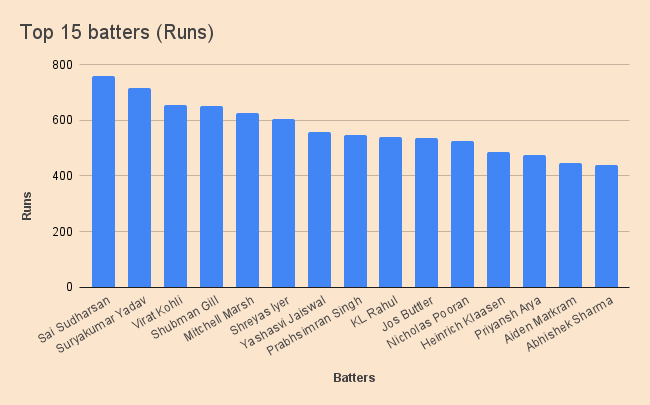
    But who were the top batsmen? Well, we’re going to focus on the top 50-60 run scorers in what follows. Without detailing who they all are here (here’s a full list that you can peruse), below are the top 15 in order of runs scored at the tournament with runs, averages and strike rates listed. These are, fairly uncontroversially, the main batting stats used in everyday parlance. Hopefully soon, RR (or RR/Inns) is added to that list one day.

    The top 15 run scorers

    Sai Sudharsan (759; 54.21; 156.17), Suryakumar Yadav, (717; 65.18; 167.91), Virat Kohli (657; 54.74; 144.71), Shubman Gill (650; 50.00; 155.87), Mitchell Marsh (627; 48.23; 163.70), Shreyas Iyer (604; 50.33; 175.07), Yashasvi Jaiswal (559; 43.00; 159.71), Prabhsimran Singh (549; 32.29; 160.52), KL Rahul (539; 53.90; 149.72), Jos Buttler (538; 59.77; 163.03), Nicholas Pooran (524; 43.66; 196.25), Heinrich Klaasen (487; 44.27; 172.69), Priyansh Arya (475, 27.94, 179.24), Aiden Markram (445; 34.23; 148.82), Abhishek Sharma (439; 33.76; 193.39).

    The top 15 Relative Runs scorers

    In terms of total RR scored, the top 15 looked liked this:

    Suryakumar Yadav (284.45), Sai Sudharsan (268.38), Mitchell Marsh (267.05), Virat Kohli (256.23), KL Rahul (227.01), Yashasvi Jaiswal (219.34), Shreyas Iyer (187.64), Jos Buttler (173.13), Shubman Gill (159.38), Heinrich Klaasen (153.23), Ajinkya Rahane (140.16), Nicholas Pooran (134.55), Prabhsimran Singh (132.64), Abhishek Sharma (105.23), Aiden Markram (98.15).

    This is an interesting list for sure but the top of the chart is naturally going to be weighted towards those who batted more. That is, those who didn’t get injured and/or went deeper in the tournament. Total runs (and by extension the ‘Orange Cap’ winner) also faces this quite obvious objection as a good measure of the best batters.

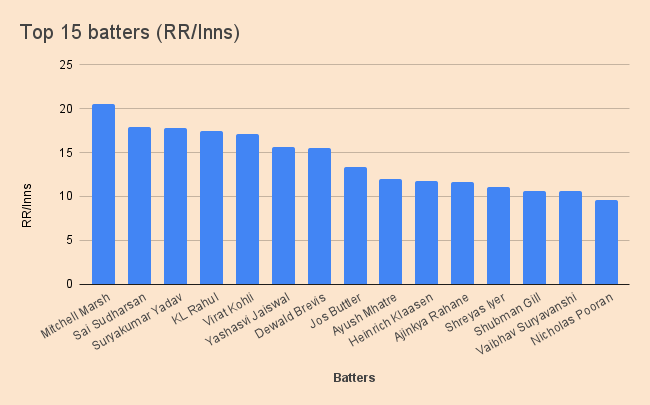
    Really, our key measure of value should be RR per innings (RR/Inns), which answers the question of how much each player contributed relatively per outing. So, let’s have a look at that list.

    The top 15 RR/Inns scorers

    In terms of RR/Inns, the top 15 looked liked this:

    Mitchell Marsh (20.54), Sai Sudharsan (17.89), Suryakumar Yadav (17.78), KL Rahul (17.46), Virat Kohli (17.08), Yashasvi Jaiswal (15.67), Dewalt Brevis (15.50), Jos Buttler (13.32), Ayush Mhatre (12.02), Heinrich Klaasen (11.79), Ajiknkya Rahane (11.68), Shreyas Iyer (11.04), Shubman Gill (10.62), Vaibhav Suryavanshi (10.59), Nicholas Pooran (9.61).

    As you can see, the 15th player is the first to drop below a RR/Inns score of 10. That means, the top 14 all contributed at least 10 runs more than the mean of the innings they batted in, on average.

    That feels like not just a nice round number to cordon off a top group, but a fair measure of an elite contribution. So, let’s consider this top 14 the elite batters according to RR in the IPL. These were the guys who did significantly better than their own teammates, game in, game out, over the season; granted, some this list only played half the matches of the group stage.

    The next group would be those who notched 5-10 RR/Inns, and then 0-5. Batters who are in the negative in terms of RR/Inns have, as intuition would suggest, scored less than Par, or less than excepted.

    In some cases, such as he case of finishers, this isn’t necessarily problematic (as mentioned above, other stats are arguably better to evaluate finishers) but for top-order (even most middle order) batters, being in the negative in terms of RR/Inns marks a batter as ‘below par’.

    Lucknow captain Rishabh Pant is a good example of a below-par batter in the top 50 total scorers. He had a pretty poor season, aside from one terrific ton in his last game. Pant scored 269 runs but his RR/Inns was -5.80. Meaning that he averaged almost 6 runs less than his side’s Par score in each innings.

    If we exclude his last innings (the third best RR score in an innings in the entire IPL season), Pant’s RR/Inns was way down at -12.57. This is really nice indication of just how poor his output was and a figure that is, arguably, more instructive than his 269 runs at an average of 24.45 and strike rate of 133.16. Although, those numbers aren’t pretty reading, either.

    Marsh in a league of his own

    Putting Pant aside, what can we learn from this data at a glance about the best batters?

    Well, what immediately stands out is how Mitch Marsh comes to the top of the pile in terms of RR per innings. What this means is that his relative contribution to his team was the greatest of any batter in the tournament. He didn’t top any charts or win any of the official awards or even make many notable Teams of the Tournament but, by this metric, he was the best batter in the 2025 IPL.

    Other standout players include the top run scorers (Sudharsan, SKY & Kohli) and, more interestingly, KL Rahul. These five (including Marsh) were the only batters to score over 17 RR/Inns. Marsh is in a league of his own, though, at 20.54.

    Many of the leading run scorers get into this top group (the top 15 of RR/Inns), which is expected as it follows that high run scorers are going to have high RR scores, but it’s not a 1:1 correlation.

    Look at the difference between Shubman Gill and his top scoring peers, his RR per innings is pretty low comparatively (10.62) despite being the fourth highest run scorer in the league. Surely, he was hampered by Sudharsan’s relatively greater success. That is, Sudharasan’s incredible season drags Gill’s numbers down a bit, in terms of RR.

    The rising stars

    Coming in at the bottom of the top 10 in terms of RR/Inns is one of the more interesting players in this analysis and that’s Dewalt Brevis. He came into the CSK lineup only for the latter half of the tournament and really impressed. So much so that his RR/Inns is one of the highest across the board, albeit derived from fewer innings than much of his competition.

    The same can be said of Brevis’ teammate Ayush Mhatre (12.02 RR/Inns) and 14-year-old Rajasthan sensation Vaibhav Suryavanshi (10.59/Inns). These three rising stars exploded in the second half of the tournament and one can only wonder what their stats would look like had they played the full league phase. Presumably, we’ll find out next season.

    The top 60 run scorers

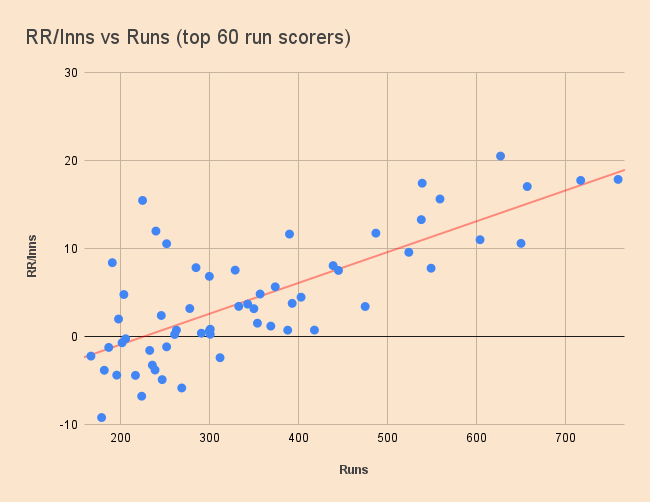
    Growing it out to the top 60 run scorers, there are some key trends. As expected, RR tracks with runs scored largely but not entirely. If they correlated exactly, it wouldn’t be a particularly interesting stat.

    As you can see in the chart above (RR/Inns vs runs), many batters loosely follow the trend line but some exist well above or below that line. These are the players that become of interest. Clearly, being well above the line suggests significant over-performance, and vice versa for being below it.

    You can see Marsh, Rahul et al. in the top right quadrant, mostly following the trend line. On the left of the chart, there is a cluster of positive outliers – Brevis, Rahane, Suryavashi and Mhatre. These guys are the lower-scoring over-performers, you could say.

    One player that is also interesting in this sense is CSK’s Rachin Ravindra. The Kiwi scored an uninspiring 191 runs (average 27.28, strike rate 128.18) but his RR/Inns score was 8.43. That is the 16th best RR/Inns in the season. However, his core stats tell a fuller story.

    The Kiwi was dropped midway through the season – essentially replaced by Mhatre/Devon Conway – due to his poor strike rate. So, while his RR/Inns was pretty impressive, there were other factors for his exclusion from the side. Also, being an overseas player, he is more prone to being dropped for such under-performance. Or rather, once he was out, it was impossible for him to get back in.

    This is an interesting case study of when RR does not tell the whole story, or might tell the wrong story. Another way of looking at this could be to say that perhaps Ravindra was a little unlucky to be completely excluded from the side and might be a good pickup for another franchise in the next auction, assuming CSK don’t retain him.

    Good, great and amazing

    Looking at the chart, the top 60 batters cluster into groups – those who scored over 500 runs, between 300 and 500, and under 300. Think of this as your run scorers being in an exceptional group, above average and decent. 300 runs is about the point where batters all go into the positive in terms of RR/Inns, hence the use of ‘above average’.

    In the elite group, it’s worth noting, having a slightly lower RR/Inns than the trend isn’t necessarily the worst thing. It can be a product of the specifics of the team in which the player exists.

    For example, the Gujarat top three (Sudharsan, Gill, Buttler) were a pretty special case this season. They all scored very heavily, remarkably so. Rarely, if ever, has an IPL side relied so much on the sustained output of a top three. What their incredible form did was lower the RR potential for each of them as none could become a huge outlier in the side. All of this adds depth to how we should read the results above.

    Sudharsan’s season was worthy of his accolades, it’s just that, according to RR, Marsh was more valuable. It’s a moot point, but it could be argued that RR shows that Marsh would have scored more for GT than Sudharsan did (if the players swapped sides), but we’d never know. I’m sure, real runs are more important than theoretical ones to many readers.

    Another point related to GT is that, just as Sudharsan was less relatively impressive than Marsh in virtue of being in a better team, Gill and Buttler were also significantly affected in terms of their RR potential by Sudharsan’s incredible season.

    Just as we could argue Marsh would score more than Sudharsan if he were at GT, one could equally argue that Gill’s objectively impressive 650 runs would have generated a higher RR score if he were in a poorer side (for example, in Marsh’s Lucknow). They would have counted for more RR in a lower scoring side but again, we’ll never know how he’d have performed in a different team context and in different match conditions.

    What we do know, though, is who wins our batting awards based on Relative Runs!

    Relative Runs batting awards for the 2025 IPL

    Most Relative Runs:

    1st: Suryakumar Yadav (284.45)
    2nd: Sai Sudharsan (268.38)
    3rd: Mitchell Marsh (267.05)

    Most RR/Inns:

    1st: Mitchell Marsh (20.54)
    2nd: Sai Sudharsan (17.89)
    3rd: Suryakumar Yadav (17.78)

    Most RR in an innings:

    1st: Abhishek Sharma (81.75 for his 141 vs Punjab Kings)
    2nd: Priyansh Arya (76.5 for his 103 vs CSK)
    3rd: Rishabh Pant (75.4 for his 118 vs RCB)